ISM Principles of Change: Difference between revisions
No edit summary |
No edit summary |
||
| Line 1: | Line 1: | ||
The ISM - Individual, Social, and Material - model is a multi-disciplinary tool to study the human | The ISM - Individual, Social, and Material - model is a multi-disciplinary tool to study the human behavior in the aspects of: behavioral economics, social psychology and sociology [GovScot.]. The model facilitates an integrated, whole-system perspective of the challenges of individuals, organizations, and partnerships. Through the process, stakeholders aim to develop a shared understanding by identifying their respective roles in bringing about change. Hereby, the model draws insight from multiple disciplines to ease the decision-making of complex problems [sustain.]. The result is a shared ownership of solutions. This is a vital part of project management to successfully transferring ownership to operations in all kind of projects [PMI]. | ||
The ISM tool was developed by researcher Andrew Darnton and launched by the Scottish Government in 2013 to evaluate the impact of sustainability challenges in certain projects [ISM]. Since it has found use for policy makers and | The ISM tool was developed by researcher Andrew Darnton and launched by the Scottish Government in 2013 to evaluate the impact of sustainability challenges in certain projects [ISM]. Since, it has found use for policy makers and practitioners to influence people's behaviors and bring about change [Govscot.]. | ||
*Background | *Background | ||
| Line 14: | Line 14: | ||
''It fosters identification and development of options and shared ownership of solutions, taking account of influences on | ''It fosters identification and development of options and shared ownership of solutions, taking account of influences on behaviors and decision-making which ultimately determine the impact of projects and actions.'' | ||
Further readings: | |||
Behavioral economics: Nudge, R. H. Thaler. | |||
Social psychology: Influence Science and Practice, R. B. Cialdini. | |||
Sociology: The dynamics of social practice, E. Shove. | |||
Revision as of 13:11, 14 February 2021
The ISM - Individual, Social, and Material - model is a multi-disciplinary tool to study the human behavior in the aspects of: behavioral economics, social psychology and sociology [GovScot.]. The model facilitates an integrated, whole-system perspective of the challenges of individuals, organizations, and partnerships. Through the process, stakeholders aim to develop a shared understanding by identifying their respective roles in bringing about change. Hereby, the model draws insight from multiple disciplines to ease the decision-making of complex problems [sustain.]. The result is a shared ownership of solutions. This is a vital part of project management to successfully transferring ownership to operations in all kind of projects [PMI].
The ISM tool was developed by researcher Andrew Darnton and launched by the Scottish Government in 2013 to evaluate the impact of sustainability challenges in certain projects [ISM]. Since, it has found use for policy makers and practitioners to influence people's behaviors and bring about change [Govscot.].
- Background
- The three aspects
- Usage
- Limitations
- References
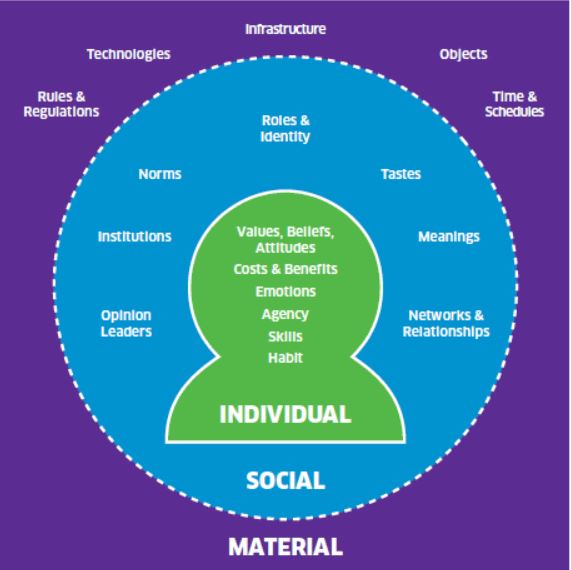

It fosters identification and development of options and shared ownership of solutions, taking account of influences on behaviors and decision-making which ultimately determine the impact of projects and actions.
Further readings: Behavioral economics: Nudge, R. H. Thaler. Social psychology: Influence Science and Practice, R. B. Cialdini. Sociology: The dynamics of social practice, E. Shove.